
By Torin Record-Sand
Reporting for West Seattle Blog
The organization SR3 most often comes to Alki for the activities embodied in its name – Sealife Response + Rehab + Research.
At Alki Coffee Company on Saturday, the activities were education and outreach.
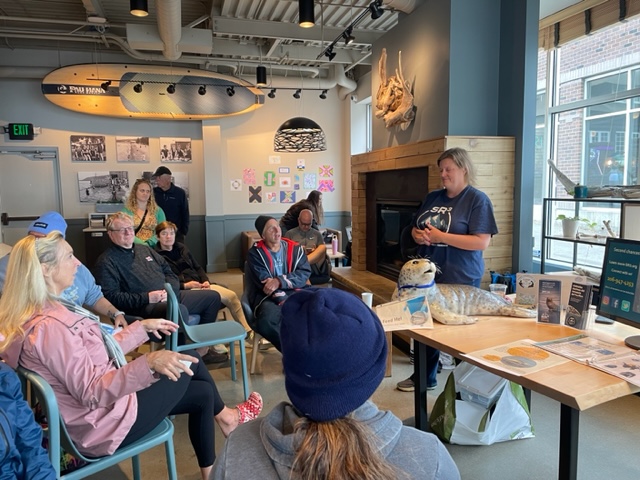
A group gathered at the coffee shop to listen to Casey Mclean, founder and executive director of SR3, which she launched in 2010 as a response to the lack of a marine mammal rescue group in the Pacific Northwest. She summarized her aim at the beginning of her presentation: “I was shocked there was nowhere for sick and injured marine mammals to go. I said, someone should do something about this, and someone said, ‘YOU should do something about this’.”
Mclean’s presentation went over the core tenets of their organization. She covered the ways in which they respond to marine mammal distress, how they rehabilitate marine mammals, and how they research the conditions of marine mammals in this region. She started with a summation of why the work matters: “All of these animals are apex predators, they speak to the health of our ocean overall. If they are sick, everything below them is going to be sick as well. Ultimately this affects all human life.”
The response efforts, she said, cover three main issues that cause serious distress in marine mammals: emaciation, disease, and direct human interaction (such as gunshots, unnecessary human touch, or interaction with domestic animals such as dogs). Their organization, she said, is ready to respond whenever. “We are ready 365 days a year, 24/7. Times aren’t necessarily convenient. The animals need you most right before dawn, right before it gets dark, and on holidays.”
 (WSB file photo)
They have both a dedicated ambulance and a truck ready to respond to incidents.
She said the number of reported incidents has increased since the 1990s. This represents a dual-edged sword: “There are more people who are spotting them, there’s more people who live here and we understand why the animals are important – so that’s positive.” but, she said, “There are also issues with the populations, the populations have grown because there is less hunting, so there are more animals now impacted by humans.”
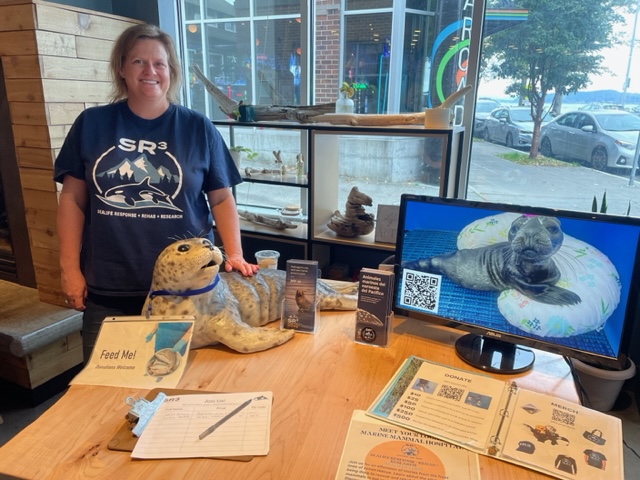
For the rehabilitation portion of the presentation, she went over the details of the SR3 facility in Des Moines, which has been operating since 2021. She provided some statistics: They receive around 600 calls a year, and currently are actively treating around 188 marine mammals. They actively teach students and volunteers in the marine veterinary field, in addition to their primary staff, they’ve taught around 45 students, and have 225 volunteers, who put in around 10,000 hours of volunteer work a year.
Primarily, they care for the marine mammal species most commonly encountered in the Northwest: Harbor seals and their pups, sea lions, and sea otters. But she highlighted that recent patients have included less-often-seen animals, such as a porpoise and sea turtles
The sea turtles, she said, represent the pace of the rapidly changing climate. “We recently treated loggerhead turtles. Only eight have been documented [in the region] throughout the past 25 years, but we had four over the past few years.” The reason, she said, was “Global warming causes new migration patterns. They just follow the warm water, then they get pushed into our cold water.”
For research, she went over their work in studying zoonotic disease outbreaks. “We’re trying to detect things before they happen. Avian influenza is an example. It went from birds to marine mammals, and we can detect that.” she said. The previously mentioned rare rescue of a porpoise also provided an insight to new research: “[They] had a parasite that we have never seen interact with the porpoise in this specific way, causing neurological damage.”
She also went over their work in studying and tracking orca pods from the air, with drones. Mclean said frequently they have shared this information with government entities in both the United States and Canada, which has led to changes in regulation to help protect the whales.
She finished with details on how people can help SR3. She recommended looking at options to volunteer or donate to the organization, and pointed at the organization’s website for both. She said that while the organization is for the most part private, there are also ways for the public to interact with it, such as fundraisers, or their yearly open house. There will be another open house next April.
She shared one last highlight on something which she felt would have the most impact for the organization: contacting local legislators about state legislation. She highlighted that there is a current bill (HJM 4004), text available here, for the government to authorize the killing of seals and sea lions to protect local salmon populations. The bill has gone through one committee, but is still waiting for a House vote, which will likely occur in the nexxt session.
She feels that this bill will be incredibly harmful to the local marine mammal population. “This bill won’t help salmon or whales. If we kill the seals that are eating salmon, we will also hurt the whales that are dependent on seals as available prey.” She detailed that the population of harbor seals in the Pacific Northwest has remained steady since the 2000s, even while the salmon population has declined. “They [state legislators] have tried to do measures like this in some way since 2008, it does not change anything, salmon populations are still declining.” she said. She encouraged the group gathered there to contact their local legislators to encourage them to vote against the bill.
The audience was composed mostly of members from local open-water swim groups, including the Notorious Alki Swimmers and the Vashon Open Water Swimmers. Both groups were finishing up a swim that afternoon near Alki. We spoke to one swimmer about their interest in why they were there to attend the event: “We encounter the seals a lot when we swim, they have an endearing curiosity for humans, and come right up to us while we’re on the water. You develop a great respect for them.”
https://ift.tt/GgpKCAU
Comments
Post a Comment